

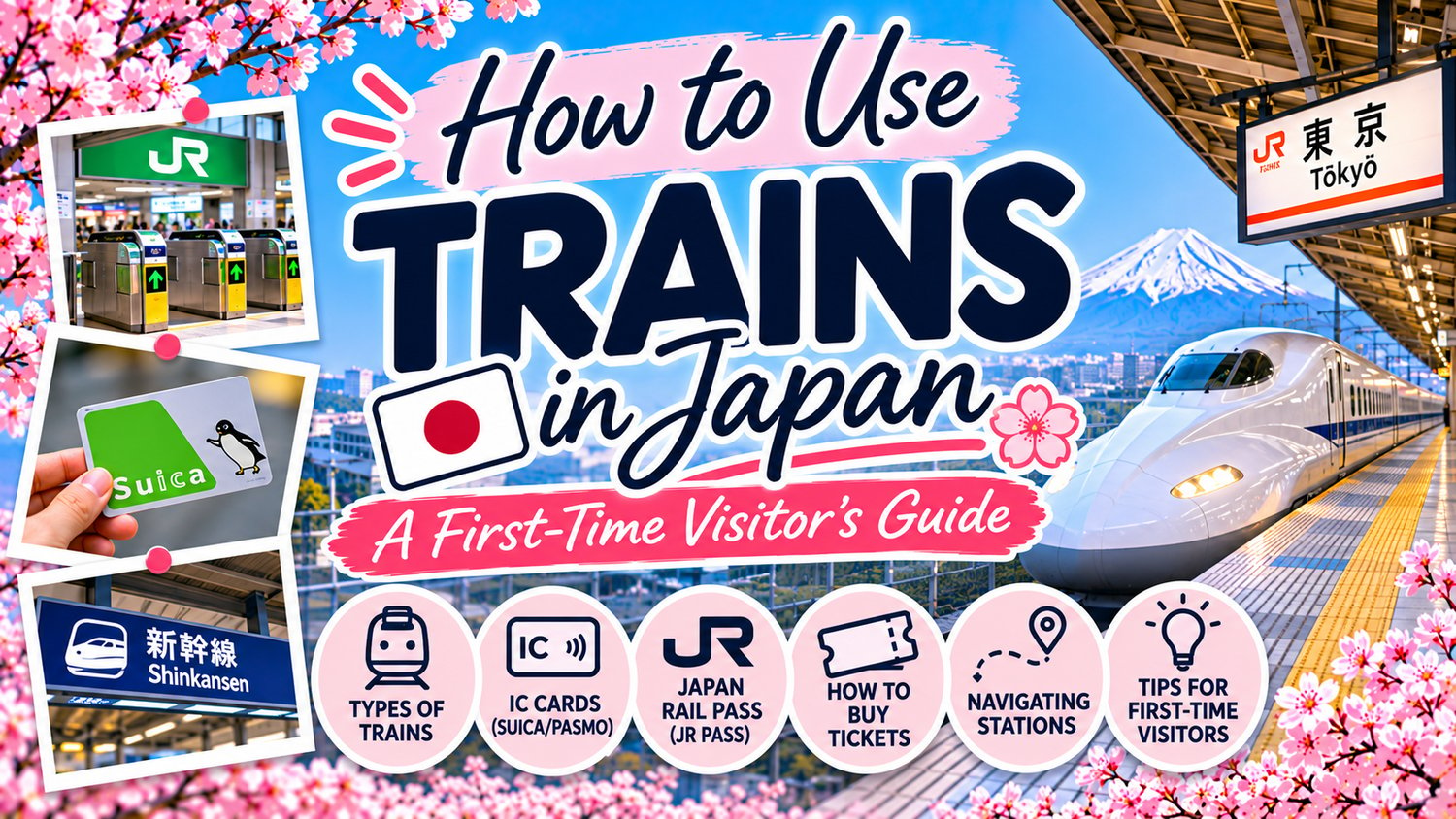
If you're planning your first trip to Japan, one of the things you might be wondering about is how you're going to get around.
Japan has one of the most extensive and convenient public transport networks in the world. Trains connect major cities, smaller towns, airports and popular tourist attractions, making them one of the easiest ways to explore the country.
But if you've never used Japan's train system before, it can look a little overwhelming.
You'll come across different railway companies, multiple train lines, local trains, rapid services, limited express trains, bullet trains, ticket machines and enormous stations with seemingly endless platforms.
And then there's the question of whether you need a Japan Rail Pass, how to pay for your journeys and how to work out which train you actually need to catch!
The good news? You don't need to understand every part of Japan's railway network to get around confidently.
Once you understand a few basics, know how to plan your journeys and have a convenient way to pay, travelling by train becomes much easier.
In this guide, we'll walk through everything you need to know about using trains in Japan, including how to navigate stations, use IC cards, buy tickets, change trains, ride the Shinkansen and keep your transport costs under control.
Whether you're catching your first train in Tokyo or travelling between Tokyo, Kyoto, Osaka and Hiroshima, this guide will help you feel much more prepared.
Understanding Japan's Train System
The first thing to understand, is that Japan doesn't have one single train company or railway network.
Instead, the country has several railway operators, and you'll often use a combination of them during your trip.
This is especially the case in larger cities like Tokyo and Osaka, where different companies operate different lines.
Here are the main types of railway operators you'll come across.
JR – Japan Railways
JR, short for Japan Railways, is a group of railway companies operating throughout Japan.
You'll probably use JR services during your trip, particularly when travelling between major cities.
Some of the main JR companies include:
- JR East: Covers Tokyo and much of eastern Japan.
- JR Central: Operates the Tokaido Shinkansen, connecting Tokyo, Kyoto, Osaka and beyond.
- JR West: Covers areas including Kyoto, Osaka, Hiroshima and western Japan.
- JR Kyushu: Operates trains throughout Kyushu.
- JR Hokkaido: Operates railway services throughout Hokkaido.
- JR Shikoku: Operates railway services throughout Shikoku.
JR also operates local commuter trains in major cities, so you'll likely use these alongside other railway operators.
Tokyo Metro and Toei Subway
When exploring Tokyo, you'll also use the city's subway network. Tokyo Metro and Toei Subway are separate operators from JR. Their trains connect many popular neighbourhoods and attractions, making them incredibly useful for sightseeing.
For example, you might use the subway to travel between areas such as:
- Asakusa
- Ginza
- Shibuya
- Roppongi
- Akihabara
- Omotesando
Tokyo's subway system is extensive, but don't let the number of lines put you off. You can use Google Maps to work out which line you need and where to transfer.
Private Railway Companies
You'll also come across privately operated railway companies, particularly around larger cities.
Some examples include:
- Hankyu Railway
- Keihan Railway
- Odakyu Railway
- Keisei Railway
- Tobu Railway
- Hanshin Railway
These services can be particularly useful for reaching certain attractions, neighbourhoods and destinations outside the main JR network.
The important thing to remember: You don't need to memorise all the railway companies. Google Maps and train planning apps will help you work out which operator and train to catch for each journey.
Understanding the Different Types of Trains
Once you start looking at train routes in Japan, you'll notice that services have different names.
Understanding what these mean will help you choose the right train and avoid accidentally boarding a service that takes much longer than expected.
Here are the main types you'll come across.
Local Trains
Local trains stop at every station along their route. They're useful for shorter journeys and getting around cities, but they can take longer because they make frequent stops.
Rapid Trains
Rapid trains skip some smaller stations, meaning they can get you to your destination faster than a local service. On many railway networks, the basic fare is the same as a local train.
Express Trains
Express trains stop at fewer stations than rapid services and can be useful for travelling longer distances. The fare rules depend on the railway operator and service.
Limited Express Trains
Limited Express trains generally connect major stations and popular destinations. Unlike ordinary local and rapid trains, these often require an additional limited express ticket on top of the basic fare. Some services also require a seat reservation.
You might encounter these when travelling to destinations such as Nikko, Hakone or other popular sightseeing areas.
Shinkansen – Bullet Trains
The Shinkansen is Japan's famous high-speed railway network, connecting major cities throughout the country. You'll most likely use the Shinkansen if you're travelling between destinations such as Tokyo, Kyoto, Osaka and Hiroshima.
Shinkansen tickets work differently from ordinary local train tickets, so we'll cover those in more detail later.
A helpful tip: When checking train routes, pay attention to the train type, departure time, platform, direction and number of stops. A slightly slower service might be easier if it means fewer transfers.
How to Plan Your Train Journeys Using Google Maps
If there's one app I'd recommend downloading before your trip, it's Google Maps. It's incredibly useful for navigating Japan's train network, especially when you're visiting for the first time.
You can use it to work out:
- Which train to catch.
- Which station to depart from.
- Which platform you need.
- How many stops you'll travel.
- Where you need to change trains.
- How long your journey will take.
- Which station exit to use when you arrive.
How to Plan a Train Journey
- Open Google Maps.
- Enter your starting location and destination.
- Select the public transport icon.
- Look through the suggested routes.
- Check the departure time and train line.
- Check the platform and number of transfers.
- Follow the directions to your station and platform.
Google Maps will usually provide several route options, so compare them before choosing one.
Sometimes the fastest route involves multiple transfers, while another option might take a few minutes longer but be much easier to navigate.
If you're new to Japan, I'd often choose the simpler route.
What Should You Look For?
When looking at your suggested route, pay attention to these details.
Departure Station
Make sure you're heading to the correct station. Some cities have several stations with similar names.
Train Line
Check the name and colour of the line you're travelling on.
Platform Number
This tells you where to board your train.
Direction
Check the train's final destination or direction of travel.
Transfers
See whether you'll need to change trains and how much time you have.
Arrival Station
Double-check that you're getting off at the correct station, particularly if there are multiple stations serving the same area.
Is Google Maps Accurate in Japan?
Google Maps is generally very helpful for navigating public transport in Japan.
However, it's still important to check station signs and departure boards. Train schedules can change, platforms can vary and disruptions may affect your journey.
I recommend checking your route before leaving your accommodation rather than trying to work everything out once you're standing in a busy station.
My tip: Save your accommodation location in Google Maps before you arrive. After a long flight, the last thing you want is to be trying to remember the name of your hotel while navigating a busy station!
Understanding Japanese Train Station Signs
One thing that can feel intimidating when you first arrive in Japan is navigating the train stations. Some of the larger stations, particularly Tokyo Station, Shinjuku Station and Shibuya Station, are enormous and can feel like entire cities of their own.
The good news is that major train stations generally have signs in both Japanese and English. Here are a few things to look for.
Station Names and Numbers
Many train lines use station codes alongside their names.
For example, Tokyo Metro stations display a letter representing the line and a number representing the station. This makes it easier to identify where you are, even if you're unfamiliar with Japanese characters.
Platform Numbers
Once you enter the station, look for signs showing the platform number for your train. You may also see the train's destination, departure time and service type displayed above the platform.
Train Direction
Pay attention to the final destination displayed on the train or station signs. Some platforms serve trains travelling in opposite directions, so make sure you're boarding the correct one.
Station Exits
Large stations can have dozens of exits, and choosing the wrong one can mean a much longer walk.
Google Maps often provides an exit number or name for your destination. Check this before leaving the station, particularly if you're trying to find a specific attraction or hotel.
A little tip: Don't feel like you need to rush. Take a moment to check the signs, look at your map and make sure you're heading in the right direction.
Using an IC Card in Japan – Suica, PASMO and ICOCA
One of the easiest ways to pay for public transport in Japan is with a rechargeable IC card.
These are prepaid travel cards that allow you to tap on and off at train stations instead of buying an individual ticket for every journey.
Think of them as Japan's version of a tap-and-go transport card.
The most commonly recognised cards include:
- Suica: Issued by JR East.
- PASMO: Issued by private transport operators in the Tokyo area.
- ICOCA: Issued by JR West.
There are also other regional IC cards throughout Japan. Although different companies issue these cards, many are interchangeable across participating transport networks.
This means you generally don't need a separate card for Tokyo, Kyoto and Osaka.
How Does an IC Card Work?
- Add money to your card.
- Find the IC card reader at the ticket gates.
- Tap your card when entering the station.
- Travel to your destination.
- Tap your card again when exiting.
The correct fare is automatically deducted from your card balance. If you don't have enough money on your card when exiting, you'll usually need to top it up at a fare adjustment machine before passing through the gates.
Where Can You Get an IC Card?
Physical IC cards are available from participating railway stations and ticket machines.
There are also special versions for international visitors, including:
- Welcome Suica: A tourist IC card available through JR East.
- TOURIST PASMO: A tourist-focused PASMO card.
Mobile versions of IC cards are also available through supported smartphone wallets. If you're travelling from Australia, check your phone's compatibility and payment options before relying on a mobile IC card. Not every overseas device or payment card will work.
How Much Money Should You Load Onto Your Card?
This depends on how often you plan to use public transport.
I'd recommend starting with a small amount and topping it up as you go. You can generally recharge physical IC cards at participating station ticket machines.
Remember that your card balance is separate from any rail pass or Shinkansen ticket you might purchase.
Can You Use an IC Card for More Than Trains?
Yes! Many IC cards can also be used at:
- Participating buses.
- Convenience stores.
- Vending machines.
- Some restaurants and shops.
- Certain station lockers.
Just remember that not every business or transport service accepts every IC card.
Important Things to Know About IC Cards
Although IC cards are accepted across many major transport networks, there are some limitations.
You generally cannot use an IC card to travel seamlessly across every regional IC card area. Some longer journeys also require a paper ticket or separate fare.
IC cards are also not a replacement for Shinkansen tickets or all limited express tickets.
My recommendation: Get comfortable using an IC card for everyday local transport. It makes travelling around cities much easier!
Buying Individual Train Tickets
Although IC cards are convenient, you might occasionally need to buy an individual train ticket.
This is particularly common when travelling on certain limited express services, Shinkansen journeys or routes that aren't covered by your IC card.
Most major train stations have ticket machines with English language options.
How to Buy a Basic Train Ticket
- Find a ticket machine near the station gates.
- Select the English language option.
- Choose your destination or fare.
- Check the fare displayed on the screen.
- Select the number of tickets you need.
- Pay using one of the accepted payment methods.
- Collect your ticket.
Some machines may ask you to select a fare rather than a destination, so check the fare map above the machines if needed.
What If You Buy the Wrong Fare?
Don't panic! Many stations have fare adjustment machines near the ticket gates.
If you arrive at your destination and your ticket doesn't cover the full fare, you can usually use one of these machines to pay the difference before exiting.
You can also ask station staff for assistance if you're unsure what to do.
Can You Buy Tickets at the Station?
Yes. You can generally purchase ordinary train tickets from ticket machines at stations.
For certain longer-distance journeys, reserved seats and Shinkansen services, you can also purchase tickets from ticket offices or official online booking services.
If you're travelling during a busy period, booking ahead can be a good idea.
How to Get Through Train Ticket Gates
Once you've got your IC card or paper ticket, getting through the gates is straightforward.
If You're Using an IC Card
- Find the gate with the IC card reader.
- Tap your card on the reader.
- Wait for the gate to open.
- Walk through.
When you reach your destination, tap your card again at the exit gates. Make sure you're using the same card when entering and exiting.
If You're Using a Paper Ticket
- Insert your ticket into the ticket slot.
- Walk through the gate.
- Remember to collect your ticket if it comes out at the other end.
Some tickets are retained by the gate, while others need to be collected for use at your destination.
What If the Gate Doesn't Open?
There are a few reasons this might happen.
- Your IC card might not have enough money.
- The reader might not have registered your card correctly.
- You might have accidentally entered a different ticketed area.
- Your paper ticket might not cover the journey.
Don't keep tapping repeatedly or try to push through. Look for a nearby station attendant or ticket office and ask for assistance.
Changing Trains and Navigating Transfers
Changing trains in Japan can seem confusing at first, especially when you're travelling through a large station. However, once you understand what to look for, it's much easier.
When planning a journey, Google Maps will show you if you need to transfer between trains.
For example, your journey might look like this:
- Board a JR train at your starting station.
- Travel several stops.
- Get off at a connecting station.
- Follow the signs for another train line.
- Board your next train.
Do You Need to Exit the Ticket Gates When Changing Trains?
Not always. If you're changing between services within the same station or connected ticketed area, you may be able to follow the transfer signs without exiting the gates.
However, if you're changing between different railway operators, you may need to pass through a transfer gate or exit one ticketed area and enter another.
Follow the signs and instructions for your particular route.
How Much Time Should You Allow for Transfers?
If you're unfamiliar with the station, I recommend allowing extra time. A transfer that looks like two minutes on Google Maps might involve walking through a large station, finding another platform or navigating a different ticket gate.
For your first few journeys, don't be afraid to choose a route with a slightly longer transfer time.
What About Changing Between JR and Subway Lines?
This is particularly common in Tokyo.
For example, you might travel on a JR line and then transfer to a Tokyo Metro service. Because these are separate railway operators, you may need to exit one ticketed area and enter another.
If you're using an IC card, the fare is generally calculated as you travel through the participating networks.
If you're using paper tickets, you may need separate tickets or a specific transfer ticket.
My tip: If Google Maps shows multiple transfers, take a screenshot of your route before leaving your accommodation. It can be helpful to have the journey available even if your internet connection is unreliable.
Riding the Shinkansen – Japan's Famous Bullet Train
No trip to Japan feels complete without experiencing the famous Shinkansen!
These high-speed trains connect major cities throughout Japan and are one of the most convenient ways to travel longer distances.
Popular routes include:
- Tokyo to Kyoto.
- Tokyo to Osaka.
- Tokyo to Hiroshima.
- Kyoto to Osaka.
- Osaka to Hiroshima.
The Shinkansen is different from ordinary commuter trains, so there are a few things worth understanding before your first journey.
What Are the Different Shinkansen Services?
You'll see several different Shinkansen service names depending on the route.
On the Tokaido Shinkansen between Tokyo, Kyoto and Osaka, the main services are:
Nozomi: The fastest service, stopping at fewer stations.
Hikari: A slightly slower service with additional stops.
Kodama: Stops at every station along the route.
The best option depends on your destination and schedule.
Other Shinkansen routes have their own service names, so don't assume the same services operate everywhere.
How Do You Buy Shinkansen Tickets?
You can purchase Shinkansen tickets through:
- Official online booking services.
- Ticket machines at major stations.
- JR ticket offices.
One popular option for the Tokaido, Sanyo and Kyushu Shinkansen is SmartEX. You can select your travel date, departure time, destination, seat type and whether you'd like a reserved or non-reserved seat where available.
Reserved Versus Non-Reserved Seats
When booking your Shinkansen ticket, you'll generally see two options.
Reserved Seats
You select a specific seat on a specific train. This is a good option if you want to know exactly where you'll be sitting.
Non-reserved Seats
You can sit in an available non-reserved seat in the designated carriages, subject to the train's arrangements.
Some services or travel periods have different seating arrangements, so check the details when booking. If you're travelling with a group and want to sit together, reserved seats are usually the better option.
How Early Should You Arrive?
I recommend arriving at the station with plenty of time to find your platform, locate your carriage and grab any food or drinks before boarding. Large stations can be busy, and it's much nicer not to feel rushed.
What About Luggage on the Shinkansen?
This is something worth understanding before you travel.
On the Tokaido, Sanyo and Kyushu Shinkansen, luggage with combined dimensions of more than 160 cm and up to 250 cm requires a seat reservation with an oversized baggage area.
Smaller suitcases can generally be stored in the overhead racks or at your feet, depending on their size.
If you're travelling with a large suitcase, check the luggage rules and book the appropriate seat before your journey.
Luggage rules can differ between Shinkansen routes, so check the operator's requirements for your specific train.
Can You Eat on the Shinkansen?
Absolutely! Long-distance trains are one of the places where eating is perfectly acceptable. You might like to pick up an ekiben, which is a Japanese boxed meal sold at many stations, before boarding. It's a lovely part of the experience!
Do You Need a Japan Rail Pass?
The Japan Rail Pass is a popular option for international visitors, but it's not automatically the cheapest way to travel around Japan. The nationwide Japan Rail Pass provides access to eligible JR services for a set period.
You can choose from:
- 7 consecutive days.
- 14 consecutive days.
- 21 consecutive days.
There are Ordinary and Green Car options.
How Much Does the Japan Rail Pass Cost?
The adult Ordinary pass prices currently listed by the official Japan Rail Pass website differ depending on where you purchase.
7 days: ¥50,000 - ¥53,000
14 days: ¥80,000 - ¥84,000
21 days: ¥100,000 - ¥105,000
These are Japanese yen prices. The amount you'll pay in Australian dollars will depend on the exchange rate and your purchase provider.
Always check the official website before purchasing, as prices and conditions can change.
What Does the Japan Rail Pass Include?
The nationwide pass covers eligible JR trains throughout Japan, including many Shinkansen and local JR services. However, it doesn't cover every train in Japan.
For example:
- Tokyo Metro and Toei Subway services are not generally included.
- Private railway companies are not generally included.
- Some special services require additional tickets or fees.
- Nozomi and Mizuho Shinkansen services require a special additional ticket when using the nationwide pass.
Always check whether your planned journeys are covered.
Is the Japan Rail Pass Worth It?
For many first-time visitors following a typical Tokyo, Kyoto and Osaka itinerary, buying individual tickets may work out cheaper.
The pass is more likely to offer value if you're travelling longer distances and making several eligible JR journeys within the pass period.
Before purchasing one, work out the cost of your planned journeys and compare it with the pass price. You should also consider whether all your longer journeys fall within the same 7, 14 or 21-day period.
My advice: Don't buy a JR Pass just because you've heard it's something tourists need. Plan your itinerary first, calculate your train costs and then decide.
Getting From the Airport Into the City
Your first train journey in Japan might actually be from the airport to your accommodation! The best option depends on which airport you're arriving at and where you're staying.
The two main international airports serving Tokyo are Narita International Airport and Haneda Airport.
Arriving at Narita Airport
Narita International Airport is located outside central Tokyo. Popular transport options include:
Narita Express (N'EX)
A JR service connecting Narita Airport with major destinations including Tokyo, Shinagawa, Shibuya and Shinjuku.
Keisei Skyliner
A limited express service connecting Narita Airport with areas including Nippori and Ueno.
Airport buses
Airport buses can be convenient for certain accommodation locations, particularly if you have luggage.
Arriving at Haneda Airport
Haneda Airport is much closer to central Tokyo. Popular options include:
Keikyu Line
Connects the airport with Shinagawa and other destinations.
Tokyo Monorail
Connects Haneda Airport with Hamamatsucho, where you can transfer to other JR services.
Airport buses
Another convenient option depending on where you're staying.
Which Airport Transfer Should You Choose?
Before you arrive, check which airport you're flying into and plan the easiest route to your accommodation. You don't necessarily need the fastest option.
If you're arriving after a long flight with several suitcases, a direct service or airport bus might be worth the extra cost.
My tip: Save your hotel's address in Japanese as well as English. This can make asking for directions or confirming your destination much easier.
Train Etiquette – Things to Know Before You Travel
Japan's public transport system is known for being efficient, clean and organised. There are a few simple etiquette rules worth knowing before you travel.
Keep Your Voice Down
Japanese trains are generally quiet environments. Avoid speaking loudly, playing music through speakers or having phone conversations while on the train.
Take Your Backpack Off
If you're travelling on a crowded train, take your backpack off and hold it in front of you or place it in a suitable luggage area. This helps avoid bumping into other passengers.
Let Passengers Off Before Boarding
When the train arrives, wait to the side and allow passengers to exit before getting on. You'll often see people lining up in designated spaces on the platform.
Don't Block the Doors
Move away from the doors once you've boarded, particularly during busy periods. Keep suitcases and bags out of the aisles where possible.
Be Mindful of Eating and Drinking
Eating and drinking are generally acceptable on long-distance trains such as the Shinkansen. On ordinary commuter trains, it's best to avoid eating, particularly when services are crowded.
Give Priority Seats to Those Who Need Them
Priority seating is available for passengers who may need it, including elderly people, pregnant passengers and people with disabilities.
Keep Your Phone on Silent
Avoid making phone calls inside train carriages. On long-distance trains, designated areas between carriages may be available for phone calls.
Queue Before Boarding
Look for the markings on the platform and line up where indicated. Wait for passengers to exit before boarding. A little consideration goes a long way when using public transport in Japan.
Travelling With Luggage on Japanese Trains
If you're travelling around Japan with a suitcase, it's worth thinking about how you'll manage your luggage before you arrive.
Japanese trains are generally very convenient, but not every train has large luggage storage areas. This can be particularly challenging during busy periods.
Can You Take Suitcases on Trains?
Yes, you can take luggage on trains, but you need to be mindful of the space available. Smaller suitcases can generally be stored near your seat or in overhead racks where suitable. Avoid blocking aisles, doors or other passengers.
What About Large Suitcases on the Shinkansen?
For certain Shinkansen services, oversized baggage reservations are required when your suitcase has combined dimensions of more than 160 cm and up to 250 cm.
This is particularly important on the Tokaido, Sanyo and Kyushu Shinkansen.
If you're travelling with a large suitcase, check the requirements and reserve the correct seat before your journey.
Consider Using Luggage Delivery Services
One of my favourite tips for travelling around Japan is to look into luggage forwarding services.
These services allow you to send your suitcase from one hotel to another, meaning you can travel with a smaller overnight bag.
This can make travelling between cities much easier, especially if you're using several different trains.
You can often arrange luggage delivery through your hotel or a luggage delivery counter.
Just remember that delivery usually takes time, so don't send your suitcase somewhere you'll need it immediately.
Travelling During Peak Hours
Japan's major cities can get incredibly busy, particularly during weekday commuting hours.
If you're travelling around Tokyo or Osaka, it's worth being aware of peak periods. Morning and evening rush hours can be particularly crowded. If possible, try to avoid travelling with large suitcases during these times.
How Can You Avoid the Crowds?
- Plan sightseeing around quieter travel periods.
- Avoid unnecessary journeys during weekday commuting hours.
- Consider walking between nearby attractions.
- Allow extra time when travelling through major stations.
- Avoid taking large suitcases on crowded commuter trains.
If you have a full day of sightseeing planned, grouping nearby attractions together can help you avoid constantly travelling back and forth across the city.
Understanding Train Costs and Budgeting for Transport
Transport can make up a significant part of your Japan travel budget, especially if you're visiting several cities.
The amount you'll spend depends on how far you're travelling, which train services you use and how often you're using public transport.
Your transport budget might include:
- Airport transfers.
- Local trains and subway journeys.
- Limited Express services.
- Shinkansen tickets.
- Private railway journeys.
- Buses and other local transport.
For everyday city travel, individual journeys are generally relatively inexpensive compared with longer-distance Shinkansen trips.
How Can You Keep Transport Costs Down?
1. Group attractions by neighbourhood
Try to visit attractions that are close together on the same day. This helps avoid unnecessary train journeys.
2. Choose accommodation near convenient train stations
Staying close to a major station can make getting around much easier and may reduce the amount of local transport you need.
3. Compare train routes before booking
The fastest route isn't always the cheapest. Look at different options before purchasing tickets.
4. Check whether a regional rail pass offers better value
Some regions have their own rail passes that may work out cheaper than buying individual tickets.
5. Don't automatically buy a nationwide JR Pass
Compare the cost of your actual journeys with the price of the pass.
6. Walk when attractions are close together
You don't need to catch a train for every journey. Walking can be a great way to explore different neighbourhoods.
Keep Your Japan Travel Budget Organised
One of the easiest ways to lose track of your travel spending is to forget how much you're spending on transport.
I recommend keeping your estimated and actual train costs in one place so you can see how they're affecting your overall budget.
This is where having a dedicated planning tool can make a difference.
Want to keep your Japan trip organised in one place?
My Japan Trip Planning Dashboard is designed to help you organise your travel budget, accommodation, flights, transport, attractions, activities and itinerary in one easy-to-use Google Sheets spreadsheet.
You can keep track of your estimated and actual expenses, so you have a clearer picture of how much you're spending and how much of your budget you have left.
EXPLORE THE JAPAN TRIP PLANNING DASHBOARD!
Planning Your Daily Itinerary Around Train Travel
Something I recommend doing before your trip is thinking about your train journeys when planning each day.
It's easy to get carried away adding attractions to your itinerary without considering how far apart they actually are.
For example, you might plan to visit three attractions in Tokyo that are spread across completely different parts of the city. While it's possible to do this, you'll spend a lot more time travelling between them.
My Tips for Planning Your Days
- Group attractions by neighbourhood.
- Check the nearest train station to each attraction.
- Look at the journey time between activities.
- Allow extra time for walking between stations and attractions.
- Avoid planning too many activities in one day.
- Keep some flexibility in your schedule.
Remember that Google Maps might show a 20-minute train journey, but you'll also need to account for getting to the station, finding your platform, waiting for the train and walking to your destination.
Keep Your Itinerary and Travel Details Together
If you prefer having your daily plans written out and organised, my Japan Trip Planner is designed to help you do exactly that.
You can use it to organise your travel details, plan your days, keep track of important information and record the places you want to visit.
It includes dedicated daily itinerary pages, so you can map out your activities and keep your plans together rather than relying on scattered notes.
EXPLORE THE JAPAN TRIP PLANNER!
Common Train Mistakes First-Time Visitors Should Avoid
Even with a little preparation, it's easy to make a few mistakes when navigating Japan's train system. Here are some things to watch out for.
1. Boarding the wrong direction
Always check the final destination displayed on the platform signs and train.
2. Confusing train operators
JR, Tokyo Metro and private railway companies are different operators. A route may involve more than one company, so check your ticket or IC card arrangements.
3. Assuming every train is covered by the JR Pass
The nationwide JR Pass doesn't cover every railway service. Check your route before travelling.
4. Not allowing enough time for transfers
Large stations can take longer to navigate than you expect. Allow extra time, especially when you're unfamiliar with the station.
5. Getting off at the wrong station
Some destinations have multiple stations with similar names. Double-check the exact station listed in your route.
6. Forgetting to top up your IC card
Check your balance before starting a journey so you don't have to stop at the exit gates to top up.
7. Travelling with oversized luggage without checking the rules
If you're taking a large suitcase on the Shinkansen, check whether you need to reserve an oversized baggage seat.
8. Trying to navigate everything at the last minute
Plan your route before leaving your accommodation. It's much easier to work out your journey when you're not standing in the middle of a busy station.
9. Assuming every station has the same layout
Every station is different. Some have multiple ticket gates, exits and connecting lines, so take your time and follow the signs.
10. Forgetting to check the last train
Most train services don't run all night. If you're planning a late night out, check the last train time so you don't get caught out.
Your Japan Train Travel Checklist
Before heading off on your Japan adventure, here's a quick checklist to help you feel prepared.
Before You Leave Australia
- Download Google Maps.
- Save your accommodation locations.
- Check your airport transfer options.
- Decide whether you'll use a physical or mobile IC card.
- Check your phone's compatibility if you plan to use a mobile IC card.
- Plan your main train journeys.
- Compare the cost of individual tickets with any rail passes you're considering.
- Check whether any journeys require reserved tickets.
- Check Shinkansen luggage requirements if travelling with large suitcases.
- Save important station and travel information.
- Keep alternative payment options available.
Once You're in Japan
- Get familiar with using your IC card.
- Check your route before leaving your accommodation.
- Check platform numbers and train directions.
- Allow extra time for transfers.
- Keep an eye on your IC card balance.
- Follow platform signs and boarding queues.
- Be mindful of other passengers.
- Check the last train time if you're out late.
Frequently Asked Questions About Using Trains in Japan
Is it easy to use trains in Japan as a tourist?
Yes! Japan's train network can look complicated at first, but major stations generally have English signage, and apps such as Google Maps make planning journeys much easier.
Once you've completed a few journeys, you'll start to feel much more confident.
Can I use the same IC card in Tokyo, Kyoto and Osaka?
Generally, yes. Major IC cards such as Suica, PASMO and ICOCA are accepted across many participating transport networks in these cities.
There can be exceptions, particularly on some routes that cross separate IC card areas, so check your journey before travelling.
Do I need to speak Japanese to use the trains?
No. You can navigate many major stations and train services without speaking Japanese. English signs and announcements are common on popular routes, and Google Maps can help you follow your journey.
Can I use Google Maps to catch trains in Japan?
Yes! Google Maps is a great tool for planning train journeys. It can show departure times, train lines, platforms, transfers and estimated travel times. Always check station information and departure boards for updates.
Should I buy a Japan Rail Pass before arriving?
You don't necessarily need one. Compare the price of the pass with the cost of your planned train journeys first. For some itineraries, individual tickets will be cheaper.
Can I use my Australian credit card to pay for trains in Japan?
Some stations and services offer contactless bank card payment, but availability isn't universal. An IC card or individual train ticket is still a reliable option to plan around. Keep a backup payment method available.
Are trains in Japan expensive?
Local train and subway journeys are generally affordable, but longer-distance journeys on the Shinkansen can add up. Your overall transport costs will depend on how many cities you visit and how far you travel.
Do trains in Japan run all night?
No. Most train and subway services stop running overnight, although operating hours vary by route. Check the last train time if you're planning a late evening out.
Can I take luggage on Japanese trains?
Yes, but you need to be mindful of the space available. Smaller suitcases can generally be stored near your seat or in overhead racks where suitable. Some Shinkansen services require reservations for oversized luggage.
Do I need to book ordinary train tickets in advance?
For most local and rapid trains, you can simply arrive at the station and use your IC card or purchase a ticket. Some limited express and long-distance services require or recommend reservations, particularly during busy travel periods.
Is the Shinkansen included in the Japan Rail Pass?
Eligible Shinkansen services are included, but there are restrictions. For example, Nozomi and Mizuho services require an additional special ticket when travelling with the nationwide Japan Rail Pass. Always check the pass conditions before boarding.
What happens if I miss my train?
For ordinary local trains, you can generally catch the next available service. For reserved Shinkansen and limited express tickets, the rules depend on the ticket type and operator. Check your booking conditions and speak to station staff if you miss your reserved departure.
Final Thoughts: Don't Let Japan's Train System Overwhelm You!
Using trains in Japan might seem intimidating before your first trip, but it's honestly one of the most convenient ways to explore the country.
You don't need to memorise every train line or understand every railway operator.
Start with the basics, use Google Maps to plan your journeys, get comfortable using an IC card and give yourself a little extra time when navigating unfamiliar stations.
Before you know it, you'll be hopping on and off trains like you've been doing it for years!
And remember, a little planning before you leave can make a huge difference once you're there.
If you're still organising your Japan adventure, take a look at my Japan Trip Planning Dashboard and Japan Trip Planner to help keep all your travel details, bookings, budget and daily plans together.
Happy travels! 🇯🇵
Updated: November 2026

Comments ()