
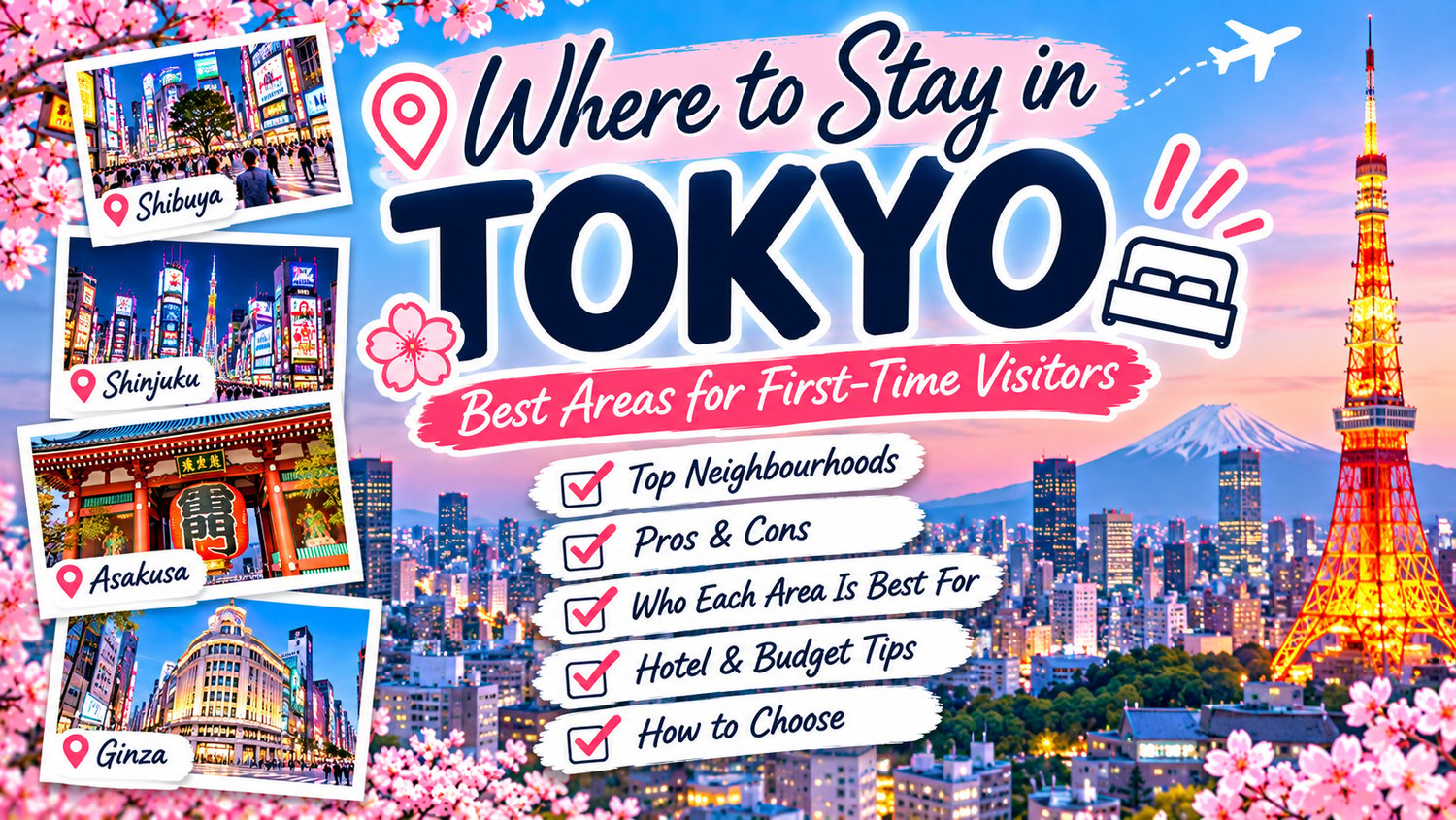
Not sure where to stay in Tokyo? This guide breaks down 7 of the best areas for first-time visitors, including what each neighbourhood is like, who it's best for, transport connections and what you can expect to pay.
Tokyo is HUGE, and choosing a hotel can feel overwhelming when you're looking at places like Shinjuku, Shibuya, Asakusa, Ueno, Ginza and Tokyo Station and wondering: "Okay... but which one is actually best for me?"
The good news is that there isn't one single "best" area to stay in Tokyo. The best area depends on what you want to do, your budget, how you like to travel and how much you value being close to transport.
For most first-time visitors, I'd start by looking at Shinjuku, Shibuya, Asakusa, Ueno, Ginza, Tokyo Station or Ikebukuro.
In this guide, I'll break down what each area is like, who it's best for, the pros and cons, and how to choose the right one for your trip.
Why your Tokyo hotel location matters
Tokyo's public transport system is fantastic, but Tokyo is also huge. Choosing a hotel because it looks cheap or beautiful without checking its location, can mean spending a lot more time getting to and from the places you actually want to visit.
And there's another important thing to remember: A hotel can say "Shinjuku" in its name without being particularly close to Shinjuku Station. Always check the actual walking distance to the station you're going to use.
FOR A FIRST TRIP, I'D PRIORITISE:
- A convenient train or subway station
- A hotel within a reasonable walking distance
- Easy access to restaurants and convenience stores
- An area you'll feel comfortable returning to at night
- A location that works with the rest of your itinerary
You don't need to stay right next to the most famous station in Tokyo.
You just need to choose a location that makes your trip easier.
1. Shinjuku
BEST FOR
First-time visitors and an all-round Tokyo experience.
If you're completely overwhelmed by where to stay, Shinjuku is probably the first area I'd look into. It's one of Tokyo's major transport hubs, with JR lines, private railways and subway lines connecting the area with a lot of the city. It's also packed with restaurants, shopping, entertainment and nightlife.
It's the kind of place where you can spend an entire day exploring and still have plenty to do when you get back to your hotel.
WHY STAY IN SHINJUKU?
- Excellent transport connections
- Huge range of restaurants
- Lots of shopping
- Plenty of hotels across different price ranges
- Great nightlife
- Easy access to other parts of Tokyo
- Plenty of convenience stores
Shinjuku also gives you very different experiences depending on which side of the station you're staying on.
The west side is generally more office-and-skyscraper focused, while the east side is much livelier, with shopping, restaurants and entertainment around Kabukicho.
THINGS TO CONSIDER
Shinjuku can be busy, noisy and overwhelming, especially around the station. And that station is HUGE. If this is your first time in Japan, don't underestimate how much easier your trip can be if your hotel is a short, straightforward walk from the station rather than a 20-minute trek through crowded streets.
MY VERDICT
Best all-round choice for first-time visitors. If you don't have a strong preference for another area, start your hotel search here.
2. Shibuya
BEST FOR
Shopping, food, nightlife and modern Tokyo
If your idea of Tokyo involves neon lights, trendy cafes, shopping and experiencing the famous Shibuya Crossing, you'll probably love staying in Shibuya.
Shibuya is one of the major centres of modern Tokyo culture, with fashion, restaurants, cafes, bars and entertainment throughout the area. And yes, the famous Shibuya Scramble Crossing really is worth seeing.
WHY STAY IN SHIBUYA?
- Amazing food scene
- Great shopping
- Lots of cafes
- Excellent nightlife
- Very modern Tokyo atmosphere
- Convenient rail and subway connections
- Easy access to Harajuku and Omotesando
Shibuya Station is served by several JR, private railway and Tokyo Metro lines, making it a useful base for exploring the city.
THINGS TO CONSIDER
Shibuya tends to be more expensive than some of the other areas on this list. It can also be very busy, particularly around the station and major shopping areas.
MY VERDICT
Best for travellers who want the energetic, modern side of Tokyo right outside their hotel.
If shopping, restaurants and nightlife are high on your list, Shibuya is a great option.
3. Asakusa
BEST FOR
Traditional Japan, atmosphere and better value
Want to wake up and feel like you're experiencing a different side of Tokyo?
Look at Asakusa.
Asakusa is centred around Sensoji Temple, Kaminarimon and Nakamise shopping street and is one of the best-known areas for experiencing Tokyo's traditional side. It's a very different atmosphere from Shibuya or Shinjuku. Asakusa Station is served by the Tokyo Metro Ginza Line, Toei Asakusa Line and Tobu Skytree Line.
WHY STAY IN ASAKUSA?
- Traditional atmosphere
- Beautiful streets and temples
- Great for photos
- Plenty of casual restaurants
- Often better value than the most central tourist areas
- Generally quieter in the evenings
- Good access to Tokyo Skytree
THINGS TO CONSIDER
You're further east than Shinjuku and Shibuya, so some destinations on the western side of Tokyo will involve a longer journey. That doesn't make Asakusa inconvenient, it just means you should consider where you'll actually be spending your days.
MY VERDICT
Best for travellers who want a calmer, more traditional Tokyo experience.
It's also one I'd look at if you're trying to keep accommodation costs under control.
4. Ueno
BEST FOR
Budget-conscious travellers, families and transport
Ueno is one of those areas that doesn't always get as much attention as Shinjuku or Shibuya, but it can be a really smart base for a first trip. Ueno has a major transport hub, Ueno Park, museums, the zoo and the lively Ameyoko shopping area.
WHY STAY IN UENO?
- Often good accommodation value
- Major train connections
- Easy access to museums and Ueno Park
- Great food
- Ameyoko shopping street
- Good option for families
- Useful if you're travelling to/from Narita Airport
Ueno Station is served by JR lines and Tokyo Metro, while Keisei Ueno provides access to the Keisei network. The official Tokyo tourism guide lists the journey from Narita Airport at around 1 hour 20 minutes by train.
THINGS TO CONSIDER
Ueno doesn't have quite the same "wow, I'm in Tokyo!" feeling as Shibuya or Shinjuku. But if you're more interested in convenience, value and transport, that might not matter at all.
MY VERDICT
One of my favourite options for travellers who want practicality over hype.
5. Ginza
BEST FOR
Couples, shopping and a more polished Tokyo experience
Ginza is where I'd look if you want your Tokyo accommodation to feel a little more upmarket and sophisticated. The area is famous for department stores, boutiques, restaurants, galleries and its polished city atmosphere.
WHY STAY IN GINZA?
- Beautiful area
- Excellent restaurants
- Great shopping
- Central location
- Good transport connections
- Close to Tokyo Station
- Lovely option for couples
Ginza has multiple subway connections, and Tokyo Station is only around 15 minutes away on foot from the Ginza area.
THINGS TO CONSIDER
Accommodation here can be more expensive, particularly if you're looking for something higher-end.
It's also not the area I'd choose if your priority is nightlife and a buzzing atmosphere until late at night.
MY VERDICT
Best for couples or travellers who want a central, polished and slightly more luxurious experience.
6. Tokyo Station
BEST FOR
Shinkansen travel and easy connections
If you're doing a classic Japan itinerary such as Tokyo → Kyoto → Osaka then staying around Tokyo Station can make a lot of sense. Tokyo Station is one of Japan's major transport hubs and is a key departure point for Shinkansen services to destinations including Kyoto.
WHY STAY NEAR TOKYO STATION?
- Extremely convenient for Shinkansen travel
- Excellent rail connections
- Easy access to Ginza
- Central location
- Great for the beginning or end of a Japan trip
- Useful if you have luggage and onward travel
THINGS TO CONSIDER
This isn't necessarily the most exciting area to stay if you're looking for nightlife and lots of casual entertainment right outside your hotel. And accommodation around here can be expensive.
MY VERDICT
Best for convenience, especially if you're travelling around Japan by Shinkansen.
7. Ikebukuro
BEST FOR
Families, shopping and a less touristy alternative
Ikebukuro is another area that deserves a look if you want excellent transport connections without staying in one of the obvious tourist bases. It's a major transport hub with JR, Tobu, Seibu and Tokyo Metro lines. It's also home to Sunshine City and has plenty of shopping, restaurants and entertainment.
WHY STAY IN IKEBUKURO?
- Excellent transport
- Huge shopping options
- Lots of restaurants
- Family-friendly attractions
- Anime and manga culture
- Can be a good alternative to Shinjuku
THINGS TO CONSIDER
If this is your first-ever trip to Tokyo, Shinjuku or Shibuya may feel more immediately "Tokyo" to you.
Ikebukuro is more of a practical base than a bucket-list destination.
MY VERDICT
Worth considering if you find a great hotel deal or want to stay somewhere slightly less tourist-focused.
So... which Tokyo area is best for YOU?
- If it's your first trip and you want everything, stay in Shinjuku. You'll have excellent transport, food, shopping, nightlife and plenty of hotel choices.
- If you love shopping, cafes and nightlife, stay in: Shibuya. You'll have modern Tokyo right outside your door.
- If you want traditional Japan, stay in Asakusa. You'll have Sensoji, traditional streets and a completely different atmosphere from western Tokyo.
- If you want to save money, stay in Ueno or Asakusa. These areas can offer better-value accommodation while still giving you good transport connections.
- If you're travelling as a couple, stay in Ginza, Shibuya or Shinjuku. Choose based on whether you prefer polished and sophisticated, trendy and energetic, or lively and convenient.
- If you're travelling with kids, stay in Ueno, Asakusa or Ikebukuro. Think about room size, station accessibility and how easy it will be to get back to your hotel after a long day.
- If you're travelling around Japan by Shinkansen, stay near Tokyo Station or Ginza. Being closer to your departure station can make luggage-heavy travel days much easier. Tokyo Station is a major Shinkansen hub with services connecting Tokyo with destinations across Japan.
What about Tokyo Disneyland?
This is one people ask me all the time. You don't necessarily need to stay beside Tokyo Disneyland for your entire Tokyo trip.
If Disney is only one day of your itinerary, I'd usually choose your Tokyo hotel based on the rest of your trip and travel to the resort for your Disney day.
However, if you're spending multiple days at Tokyo Disney Resort (or you're travelling with young children) you may decide that staying closer to the resort is worth the convenience.
Don't choose your entire Tokyo accommodation based on one day unless Disney is a major part of your trip.
How many nights should you stay in Tokyo?
For a first Japan trip, I'd recommend giving yourself at least 3 full days in Tokyo if your itinerary allows it. Four or five days gives you much more breathing room. Remember that Tokyo isn't one compact tourist area.
You might spend one day around:
Asakusa → Ueno → Akihabara
and another around:
Shibuya → Harajuku → Shinjuku
Tokyo's official tourism guide uses similar area-based itineraries, grouping nearby neighbourhoods together rather than trying to cross the entire city repeatedly. This is another reason your hotel location matters.
How to choose your actual hotel
Once you've picked your area, don't immediately book the first hotel you find.
USE THESE CHECKS
1. Check the exact station - Don't just search "Shinjuku hotel." Look at the hotel on a map and see which station entrance is actually closest.
2. Check the walking distance - I'd personally aim for around 5–10 minutes from a useful station where possible. That might not sound important now, but it will feel VERY important when you're carrying a suitcase after a 20-hour journey 😂
3. Check which train lines you can access - A hotel beside one useful train line may be more convenient than a hotel that's technically closer to a famous station but requires a complicated transfer every day.
4. Check the room size - This is especially important in Tokyo. Hotel rooms can be much smaller than Australians are used to. Check the actual room size before booking, not just the number of stars.
5. Check luggage arrangements - Look at whether the hotel offers luggage storage before check-in or after check-out. This can be incredibly useful on arrival and departure days.
6. Check the area at night - Open Google Maps and have a look at the streets around the hotel. Ask yourself: "Would I be happy walking this route back to my hotel at 10pm?"
7. Check the cancellation policy - If you're booking months in advance, flexible cancellation can be worth paying slightly more for.
One more thing Australians should know: Tokyo accommodation tax
Tokyo currently charges an accommodation tax on certain hotel and ryokan stays.
Under the current system, accommodation costing ¥10,000 or more per person per night is subject to the tax, with the current rates being ¥100 or ¥200 per person per night depending on the room charge.
However, this is changing from 1 April 2027. From that date, Tokyo's planned revised system will apply a 3% accommodation tax to eligible stays of ¥13,000 or more per person per night, with the tax also expanding to additional accommodation types.
So if you're planning a future Japan trip, check the current rules when you book rather than relying on an old travel blog.
My biggest Tokyo hotel tip
Here's the thing I wish more first-time visitors knew: Don't choose your hotel based purely on the neighbourhood name. Choose it based on the exact location.
A hotel that is technically in Shinjuku but takes 20 minutes to walk to the station might be less convenient than a hotel in a neighbouring area that's five minutes from a useful train line.
Tokyo is incredibly well connected.
You don't need to be directly beside every attraction.
You just need a good home base.
And honestly?
I'd rather stay in a smaller, simpler hotel in a fantastic location than a beautiful hotel that adds 30 minutes of travel to every day.
My Tokyo area cheat sheet
If you're still stuck, save this:
First Japan trip → Shinjuku
Modern Tokyo → Shibuya
Traditional Tokyo → Asakusa
Budget + practical → Ueno
Couples + polished → Ginza
Shinkansen + transport → Tokyo Station
Family + shopping → Ikebukuro
There isn't one "correct" choice.
The best Tokyo neighbourhood is the one that makes your particular trip easier.
Ready to plan the rest of your Japan trip?
Once you've chosen your Tokyo hotel, the next step is working out your flights, accommodation, transport, bookings, daily itinerary and budget.
That's exactly what I created my Japan Trip Planner for. It gives you one organised place to plan your trip from the early stages all the way through to your actual holiday.
Including your itinerary, accommodation, reservations, budget and all those little details you don't want to forget.
Frequently Asked Questions
What is the best area to stay in Tokyo for first-time visitors?
For many first-time visitors, Shinjuku is a great all-round choice because of its extensive transport connections, restaurants, shopping and entertainment. However, Shibuya, Asakusa, Ueno, Ginza and Tokyo Station can all be better depending on your itinerary and travel style.
Is Shinjuku or Shibuya better for first-time visitors?
Shinjuku is generally the more practical all-round base, while Shibuya is particularly appealing if you prioritise shopping, cafes, nightlife and modern Tokyo. Both have extensive transport connections.
Is Asakusa a good area to stay in Tokyo?
Yes. Asakusa is an excellent choice if you want traditional Tokyo, easy access to Sensoji and a quieter atmosphere. It also has connections via the Tokyo Metro Ginza Line, Toei Asakusa Line and Tobu Skytree Line.
Is Ueno a good place to stay in Tokyo?
Yes. Ueno is particularly useful for travellers who value transport connections, museums, parks and potentially better-value accommodation. It also has convenient rail connections toward Narita Airport.
Where should I stay in Tokyo if I'm taking the Shinkansen?
If your itinerary includes a Shinkansen journey from Tokyo, staying around Tokyo Station or nearby Ginza can make your travel day easier, particularly if you have luggage. Tokyo Station is a major Shinkansen hub.
Should I stay near Tokyo Disneyland?
Not necessarily. If you're only spending one day at Tokyo Disney Resort, it can make more sense to choose your Tokyo hotel based on the rest of your itinerary. If you're spending several days at Disney or travelling with young children, staying closer to the resort may be worth considering.
How far should my Tokyo hotel be from a train station?
For a first trip, I'd ideally look for a hotel around 5–10 minutes' walk from a useful station, although the exact distance matters less than having a straightforward route and convenient train lines.
Is Tokyo expensive to stay in?
Tokyo has accommodation across a huge range of budgets. Your price will depend on the area, room size, hotel standard and time of year. Areas such as Ueno and Asakusa can be worth investigating if you're looking for better value.
Do I need to stay in central Tokyo?
No. Tokyo's rail and subway network makes it possible to stay outside the most famous tourist areas. However, for a first trip, choosing a convenient base can save you significant time and make navigating the city easier.
Planning Your Japan Trip? 🇯🇵
Whether you're still dreaming about Japan or already counting down to your trip, I'm here to make planning a little easier. I've created practical Japan travel guides and planning resources specifically for first-time travellers, so you can spend less time figuring everything out and more time getting excited about your trip.
🎁 Start with my FREE Japan Travel Checklist
Not sure what you need to organise before Japan? My free checklist takes you through the key things to sort before your trip, so you can work through your planning step by step.
→ GET THE FREE JAPAN TRAVEL CHECKLIST
Ready to organise your whole trip?
My Japan Trip Planner brings your trip planning into one place, with space for your itinerary, flights, accommodation, reservations, wishlist, budgeting and more.

Comments ()